
Fast, Effective Relief for Stubborn Pain & Injuries
Shockwave therapy, also known as extracorporeal shockwave therapy (ESWT), is a non-invasive treatment that uses focused or radial pressure waves to target painful areas of the body.
It is commonly used as part of the treatment of persistent tendon and musculoskeletal problems, particularly when symptoms have not responded as expected to more conventional approaches.
Shockwave therapy may be used to help manage a range of conditions, including:
It can be particularly useful for long-standing or stubborn tendon problems, where recovery has been slower than expected.

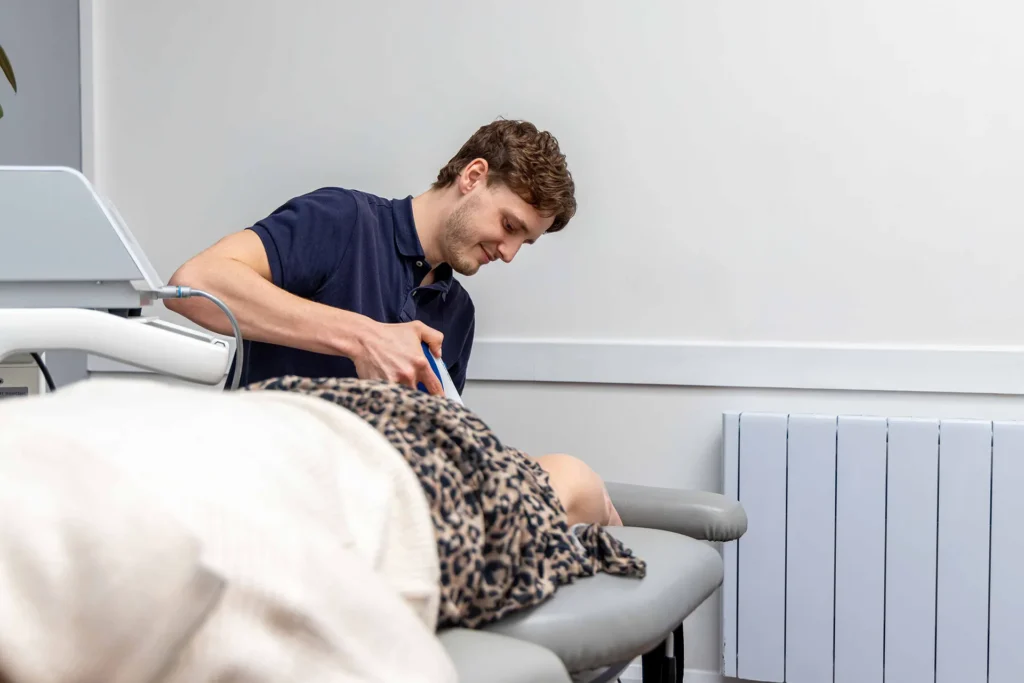
During treatment, a handheld device delivers pressure waves to the affected area. These waves stimulate the tissues and may help to reduce pain and support the body’s natural healing and recovery processes.
Treatment is usually relatively quick and does not require injections or surgery. Some patients may experience discomfort during the treatment, but the intensity can be adjusted to suit you.

At Surbiton Chiropractic Centre, we don’t see shockwave therapy as a standalone solution. It is often most effective when combined with other aspects of care.
Depending on your individual needs, this may include hands-on treatment, targeted rehabilitation exercises, strength and mobility work, and advice on managing your activity.
Your therapist will assess your condition and discuss whether shockwave therapy is appropriate for you before treatment begins.

If you’ve been dealing with a persistent tendon or musculoskeletal problem that isn’t improving as you’d expect, shockwave therapy may be worth considering.
Our team can assess your condition and explain the treatment options available, helping you choose the approach that is most appropriate for your individual needs.
Get in touch with our team to find out whether shockwave therapy could be suitable for you.

Shockwave therapy can be a useful treatment option for people with persistent tendon and musculoskeletal problems, particularly when symptoms have not responded to other conservative treatments.
Potential benefits include:

Some patients experience mild to moderate discomfort during treatment, particularly when treating a sensitive or painful area. The intensity of the treatment can be adjusted to make it as comfortable as possible.
Treatment sessions are relatively short, and some patients may experience temporary soreness afterwards. Your therapist will explain what to expect and provide advice on what to do following your treatment.

Shockwave therapy is not designed to simply treat the symptoms in isolation. At Surbiton Chiropractic Centre, we often combine it with hands-on therapy, rehabilitation, strengthening and exercise advice to address the factors contributing to your problem.
Your therapist will assess your condition and discuss whether shockwave therapy is appropriate for you before starting treatment.
If you have a persistent tendon or musculoskeletal problem, speak to our team to find out whether shockwave therapy could be part of your recovery plan.

If shockwave therapy is recommended as part of your treatment, your therapist will explain the process and make sure you are comfortable before treatment begins.
Treatment sessions are relatively short and typically take around 3-4 minutes, although this can vary depending on the area being treated and your individual condition.
A handheld shockwave device is applied to the affected area to deliver pressure waves to the tissues being treated. Your therapist will identify the appropriate area and adjust the treatment settings according to your condition and tolerance.
Shockwave therapy is often used alongside other treatments rather than in isolation. Depending on your needs, your treatment may also include hands-on therapy, stretching, strengthening and rehabilitation exercises.
Addressing the underlying factors contributing to your problem is an important part of helping you return to normal activity.
Your therapist will provide advice on what to do between sessions, including guidance on exercise, activity levels and recovery.
It is normal for the treated area to feel temporarily sensitive or sore following treatment. Your therapist will explain what you can expect and when you can return to your usual activities.
Some medications, particularly anti-inflammatory medication, may affect the body’s response to shockwave treatment. If you regularly take anti-inflammatory medication or any other medication, please let your therapist know before treatment.
Do not stop or change prescribed medication without first speaking to your doctor or healthcare professional. Your therapist can advise you on whether any medication considerations apply to your treatment.

Meet our dedicated chiropractic team, committed to providing personalized care and helping you achieve optimal health.
Most patients require between 3–6 sessions, depending on the condition and severity. Your practitioner will recommend a tailored plan during your consultation.
A typical treatment takes around 15–20 minutes, with no downtime afterwards.
Side effects are rare, but you may experience mild redness, soreness, or swelling in the treated area, which usually resolves within 48 hours.
Some patients notice improvement after the first session, but most experience significant results after 3–4 treatments.
We and our partners, including Google, use cookies and personal data to analyse traffic and for ads personalisation and measurement. You can accept, reject or choose which cookies to allow. Privacy Policy • Cookie Policy • Terms & Conditions • Google Privacy
We use cookies to help you navigate efficiently and perform certain functions. You can choose which categories to allow below. Cookies categorised as Necessary are always active.
We also use third-party cookies for analytics and advertising. These are only stored with your consent. You can update or withdraw consent at any time via the cookie icon at the bottom-left. This site operates under UK GDPR, the Data Protection Act 2018, and the Privacy and Electronic Communications Regulations (PECR). Cookie Policy • Privacy Policy
Necessary cookies are required for core site features including security, network management, and consent storage.
| Cookie | Duration | Description |
|---|---|---|
hmdg_cookie_consent | 180 days | Stores your cookie consent preferences. |
PHPSESSID | Session | WordPress session identifier. |
wordpress_logged_in_* | Session | WordPress login authentication. |
Functional cookies enable enhanced features such as live chat and remembering preferences.
| Cookie | Duration | Description |
|---|---|---|
wp-settings-* | 1 year | Stores user interface preferences. |
Analytics cookies help us understand visitor behaviour. Controls analytics_storage for Google Analytics 4.
| Cookie | Duration | Description |
|---|---|---|
_ga | 2 years | Google Analytics — distinguishes users. |
_ga_* | 2 years | Google Analytics 4 — session persistence. |
_gid | 24 hours | Google Analytics — distinguishes users. |
_gat | 1 minute | Google Analytics — throttles request rate. |
Performance cookies collect aggregate, anonymous data about site performance.
| Cookie | Duration | Description |
|---|---|---|
_gat_gtag_* | 1 minute | Google Tag Manager — rate throttle. |
Marketing cookies track visits to deliver relevant ads. Controls ad_storage, ad_user_data, and ad_personalization.
| Cookie | Duration | Description |
|---|---|---|
_gcl_au | 90 days | Google Ads — conversion tracking. |
_gcl_aw | 90 days | Google Ads — click attribution. |
_gac_* | 90 days | Google Ads — campaign information. |
IDE | 1 year | Google DoubleClick — ad targeting. |
Powered by HMDG • Cookie Policy